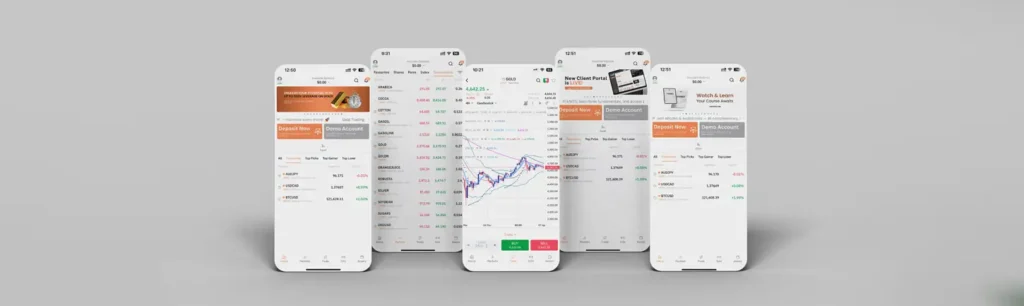
Most traders didn’t switch to mobile because they wanted to. It happened gradually. At first, the phone was just there for convenience, something to check positions or close a trade if you weren’t near your setup. Then apps got faster, more stable, and more reliable. Execution improved, charts became usable, and suddenly the gap between desktop and mobile didn’t feel as wide anymore.
That’s when behavior started to change.
Instead of being tied to a desk, traders began managing positions throughout the day. Not in a rushed or chaotic way, but in a way that felt more natural. Markets run continuously, and now access does too. A mobile trading app didn’t replace traditional platforms, but it removed the need to depend on them completely.
And once that shift happens, it doesn’t really reverse.
Why Mobile Trading Became Part of Daily Trading
The appeal isn’t just about speed or convenience. It’s about staying connected without needing to reorganize your day around the market. That’s a subtle difference, but it matters more than most people realize. Traders don’t operate in isolation. They have schedules, responsibilities, and distractions, and mobile trading fits into that reality in a way desktop platforms never could.
At the same time, the technology caught up. A modern forex trading app is no longer limited to basic functionality. You can analyze charts, place trades, adjust risk, and manage your account without feeling like you’re using a stripped-down version of something else. That level of reliability builds trust, and once traders trust the platform, they start using it more often.
But there’s another side to it.
Access changes behavior. When you can open your positions at any moment, you’re more likely to do it. Sometimes that helps. Sometimes it leads to decisions that would have been avoided if you had to wait.
Benefits of Mobile Trading
The most obvious advantage is flexibility, but that word gets used so often it starts to lose meaning. In practice, flexibility means you don’t miss trades simply because you’re not at your desk. It means you can respond to market movement when it happens, not hours later when the opportunity has already passed.
There’s also a level of awareness that comes with mobile trading. When you’re using a trading platform mobile, your positions aren’t something you check once or twice a day. They’re part of your routine. You stay informed without needing to sit in front of charts for hours, which, for many traders, actually leads to better control rather than constant stress.
Interestingly, mobile trading tends to simplify decision-making. On a smaller screen, there isn’t space for unnecessary tools or cluttered setups. Traders focus more on price action and key levels instead of overcomplicating their analysis. It’s not that mobile trading makes you better, but it removes some of the noise that often gets in the way.
Execution is another factor. When a trade setup is clear, you can act on it immediately. There’s no delay, no transition between devices, and no second-guessing caused by time gaps. That immediacy can improve consistency, especially in fast-moving markets.
Risk Management on Mobile
This is where things become less comfortable, because the same accessibility that makes mobile trading useful can also create problems. When your platform is always within reach, it’s easy to slip into habits that don’t support long-term results. Checking trades too often, reacting to small price movements, or entering positions without proper preparation becomes more likely.
Managing risk on mobile requires structure, not just awareness. You need to define your levels before entering a trade and rely on them, instead of adjusting decisions based on emotion. Stop-loss and take-profit orders are essential here, not as a technical requirement, but as a way to remove unnecessary decisions once the trade is live.
There’s also the issue of perspective. Charts on a phone don’t always show the full picture, and small movements can feel larger than they actually are. This can lead to overreactions, especially when traders are not fully focused. Many experienced traders avoid this by separating analysis from execution. They study the market on a larger screen, then use their phone to manage trades during the day.
Connection stability is another factor that doesn’t get enough attention. Trading in an unstable network environment introduces unnecessary risk. Even a short delay can affect execution, particularly during volatile conditions. It’s not something traders think about until it becomes a problem.
Best Features Traders Actually Use
Not every feature in a mobile trading app matters, even though many platforms try to include as much as possible. What traders actually rely on is much simpler.
Execution needs to be fast and consistent. If orders don’t go through immediately, the platform loses its value. That’s non-negotiable, especially in markets where timing is critical.
Charts need to be clear, not complex. Traders aren’t looking for every possible indicator on mobile. They need something they can read quickly and trust, without second-guessing what they’re seeing.
Account visibility is equally important. Knowing your margin, exposure, and open positions at a glance makes a difference when decisions need to be made quickly. If that information isn’t easy to access, it slows everything down.
Then there’s reliability, which is often overlooked until something goes wrong. A platform that works perfectly under normal conditions but struggles during high volatility creates unnecessary risk. Stability isn’t a feature that gets highlighted, but it’s one of the few that actually matters.
How Traders Actually Use Mobile Today
There isn’t one standard approach to mobile trading, and that’s part of the reason it works. Some traders rely entirely on their phone, handling everything from analysis to execution in one place. For them, simplicity is the advantage, and they adapt their strategy to fit the platform.
Others take a more balanced approach. They analyze the market on desktop platforms, where they have more space and better visibility, then use their phone to monitor positions and adjust trades throughout the day. This method keeps analysis structured while still benefiting from mobile access.
There are also traders who focus on speed. For them, the ability to trade on phone is less about convenience and more about reacting to market conditions in real time. They’re not looking for deep analysis in that moment. They’re looking for execution.
Each approach works, but they all rely on the same idea. Mobile trading isn’t replacing traditional platforms. It’s changing how traders use them.
What Mobile Trading Doesn’t Change
It’s easy to assume that better access leads to better results, but trading doesn’t work that way. The platform doesn’t fix weak strategy, and it doesn’t replace discipline. If anything, it exposes gaps more quickly, because decisions happen faster and more frequently.
Mobile trading gives you the ability to act immediately, but that doesn’t mean you should. Sometimes the better decision is to wait, and that becomes harder when your platform is always available. This is where experience matters, not the device you’re using.
Final Thought
Mobile trading isn’t new anymore. It’s already part of how the market functions. The question isn’t whether to use it, but how to use it without letting convenience take over your decisions.
If you approach it with structure, it becomes one of the most practical tools available. If you don’t, it becomes a source of unnecessary noise.
The difference isn’t in the platform. It’s in how you use it.

