

Moving Averages in Forex: SMA vs. EMA and How Crossovers Work

A moving average smooths price data by averaging closing prices over a set number of periods. The simple moving average (SMA) weights every period equally, while the exponential moving average (EMA) gives more weight to recent prices, so it reacts faster. Crossovers between a fast and a slow average are a common way to describe changing trends, but every moving average lags price and can produce false signals in sideways markets.
Leverage and Margin in Forex: Balance, Equity, Free Margin, and Margin Calls

Leverage lets a trader open a position larger than the funds in the account, and margin is the portion of those funds set aside to keep the position open. With 1:100 leverage, a $110,000 position needs $1,100 of margin. The account’s balance reflects closed trades, equity adds the running result of open positions, and free margin is equity minus the margin in use. When losses reduce equity close to the margin in use, the broker issues a margin call and, at a lower level, a stop-out closes positions automatically.
Forex Trading Hours in UAE Time: Sessions and Best Times to Trade

The forex market trades 24 hours a day from Monday morning to Saturday morning in UAE time. In Gulf Standard Time (GST, UTC+4), the week opens at about 01:00 on Monday and closes at about 01:00 on Saturday during the northern summer, or 02:00 in winter. Trading passes through four main sessions: Sydney, Tokyo, London and New York. Activity and liquidity tend to be highest when sessions overlap, especially the London–New York overlap, which runs from about 16:00 to 20:00 GST in summer and 17:00 to 21:00 GST in winter. Which hours suit a given trader depends on the instrument, the trading style and personal schedule.
Forex Scalping Strategy: How It Works, Indicators, Costs, and Risks

In short: Forex scalping is a trading style that opens and closes many positions within seconds or minutes, aiming to capture very small price moves. Because each target is only a few pips, trading costs such as spreads and commissions take up a large share of every result. Scalping also demands fast execution, strict position sizing and constant attention, and losses can build quickly.
Forex Risk Management: Position Sizing, Stop-Losses, and the 1% Rule

Forex risk management is the set of methods traders use to limit how much of their account is exposed on each trade and across all open positions. The main tools are position sizing, which sets trade size based on the amount at risk; stop-loss orders, which define an exit point if price moves against a position; and percentage limits such as the widely cited 1% rule, under which no more than 1% of account equity is placed at risk on a single trade. These methods do not prevent losses, and stops can fill at worse prices in fast markets, but they make the size of each potential loss more predictable.
Forex Order Types Explained: Market, Limit, Stop, and Stop-Limit Orders
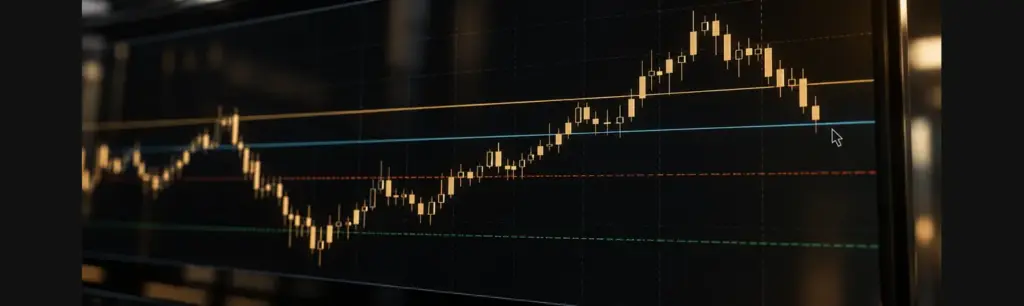
Forex order types decide how and when a trade is executed. A market order fills straight away at the next available price. A limit order waits for a better price, a stop order triggers once price reaches a less favourable level, and a stop-limit order combines both. Each type trades certainty of execution against certainty of price, and none removes the risk of slippage or gaps.
How to Trade Crude Oil: WTI vs. Brent and What Moves Prices

Crude oil is traded mainly through futures contracts on two global benchmarks, WTI (West Texas Intermediate), priced at Cushing, Oklahoma, and Brent, based on North Sea crude. Retail traders often access oil prices through contracts for difference (CFDs), which track these benchmarks without physical delivery. Oil prices respond to supply decisions by OPEC+ and other producers, global demand, weekly inventory data, the US dollar and geopolitical events. Oil can move several percent in a day, and leveraged positions can gain or lose value quickly.
How to Trade EUR/USD: Market Drivers, Trading Hours, and Key Risks

In short: EUR/USD is the exchange rate between the euro and the US dollar, and it is the most traded currency pair in the world. Its price reacts mainly to interest-rate expectations at the European Central Bank and the US Federal Reserve, inflation and jobs data, and shifts in global risk appetite. Liquidity is deepest when London and New York overlap, yet leveraged EUR/USD positions can still lose money quickly.
Forex Lot Size and Pip Value Explained (With Examples)

In forex, a lot is the unit used to measure trade size, and a pip is the standard unit for measuring price changes. A standard lot is 100,000 units of the base currency, a mini lot is 10,000 and a micro lot is 1,000. For most pairs, a pip is the fourth decimal place (0.0001); for Japanese yen pairs, it is the second (0.01). Pip value, the amount one pip is worth, equals the pip size multiplied by the number of units traded, converted into the account currency. For EUR/USD, one pip on a standard lot is worth $10.
Fibonacci Retracement in Trading: How to Draw and Use the Key Levels

Fibonacci retracement is a charting tool that marks horizontal levels at set percentages of a price swing, most commonly 23.6%, 38.2%, 50%, 61.8% and 78.6%. Traders draw it from a swing low to a swing high, or the reverse, to see where a pullback might pause. The levels are widely watched, but they are not predictive, and price often moves straight through them.