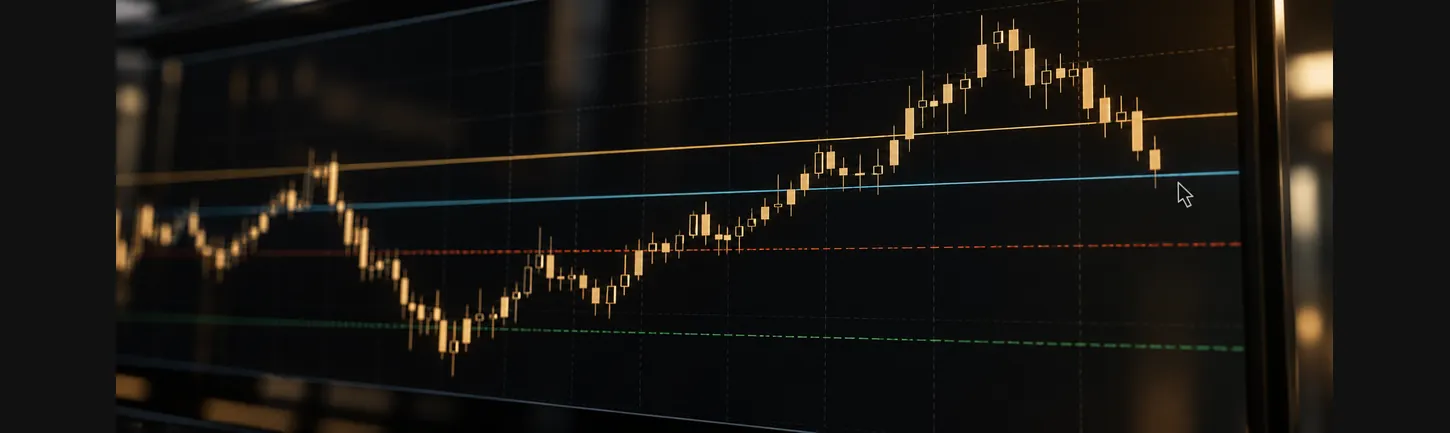
In short: Forex scalping is a trading style that opens and closes many positions within seconds or minutes, aiming to capture very small price moves. Because each target is only a few pips, trading costs such as spreads and commissions take up a large share of every result. Scalping also demands fast execution, strict position sizing and constant attention, and losses can build quickly.
Key takeaways
- Scalpers typically hold trades for seconds to a few minutes and target moves of a few pips.
- Common tools include short-period moving averages, stochastic oscillators, RSI, Bollinger Bands and volume-based signals on 1- to 5-minute charts.
- Spreads, commissions and slippage are proportionally much larger for scalping than for longer-term styles.
- Execution speed, liquidity and news timing directly affect outcomes, which makes scalping one of the most demanding short-term approaches.
What Is Scalping in Forex?
Scalping is the shortest-term trading style in the forex market. A scalper looks for small price changes, often between 2 and 10 pips, and aims to exit quickly once that move happens or fails to happen.
The idea is that many small results can add up over a session. In practice, the same logic applies to losses. A string of small losing trades, plus the cost of each entry, can reduce an account just as steadily.
Scalping sits at one end of a spectrum. Day traders hold for minutes to hours, and swing traders hold for days. CMS Prime’s comparison of day trading vs swing trading describes the other two styles in detail.
How a Scalping Strategy Works
Most scalping approaches share the same building blocks, even when the indicators differ.
- A liquid market. Scalpers usually focus on major pairs such as EUR/USD, USD/JPY or GBP/USD, where spreads are narrower and prices update continuously. CMS Prime’s online forex trading page lists the pairs available.
- A short timeframe. 1-minute and 5-minute charts are common. Some scalpers also watch a 15-minute chart to see the wider direction.
- A defined trigger. An entry rule, such as a moving average crossover or a momentum reading, tells the trader when to act.
- A fixed exit plan. Both the target and the stop-loss are set before entry. Waiting for a small target while allowing a larger loss can quickly change the maths of the approach.
- Timing. Scalpers often trade during the most liquid sessions, such as the London–New York overlap, when spreads are tighter.
Common Scalping Indicators
Scalpers tend to use indicators that react quickly. None of them predicts price. Each simply describes recent price behaviour in a different way.
Short-period moving averages
Exponential moving averages (EMAs) with short periods, such as 5, 9 or 21, are used to judge very short-term direction. A faster EMA crossing a slower one is a common trigger. EMAs also underpin the MACD, explained in CMS Prime’s MACD indicator guide.
Stochastic oscillator and RSI
Both are momentum oscillators. They show whether recent closes sit near the top or bottom of a recent range. On short timeframes, readings can swing between extremes many times a day. CMS Prime’s guide to the RSI indicator covers how the RSI is calculated and read.
Bollinger Bands
Bollinger Bands place bands two standard deviations above and below a moving average. Scalpers watch whether price touches, rides or breaks the bands, and whether the bands are narrowing or widening.
Average True Range (ATR)
The ATR measures how far price typically moves in a period. Scalpers use it to judge whether a target or stop is realistic for current conditions. Volatility itself is covered in CMS Prime’s guide to market volatility.
Price action and levels
Many scalpers rely less on indicators and more on nearby support, resistance and session highs or lows. Reading several timeframes together is covered in multiple timeframe analysis.
Why Costs Matter So Much in Scalping
Trading costs are paid on every trade, whatever its size or duration. When targets are small, those costs become a large share of each outcome.
Consider a simple example. A scalper targets 5 pips on EUR/USD, and the round-trip cost (spread plus commission) equals 1 pip. That cost is 20% of the target. A swing trader targeting 100 pips with the same 1-pip cost gives up just 1%.
The table below shows how the same cost affects different target sizes.
|
Target per trade |
Round-trip cost |
Cost as % of target |
What this means |
|
3 pips |
1 pip |
33% |
Price needs to move 4 pips in the trader’s favour to reach the target net of cost |
|
5 pips |
1 pip |
20% |
A fifth of each winning trade is absorbed by cost |
|
10 pips |
1 pip |
10% |
Costs are still significant over many trades |
|
50 pips |
1 pip |
2% |
Costs matter less relative to the move |
|
100 pips |
1 pip |
1% |
Costs are a small share of the target |
Four types of cost affect scalping in particular:
- Spread: the gap between bid and ask prices, paid on entry.
- Commission: a fixed charge per lot on some account types, often paired with narrower raw spreads.
- Slippage: the difference between the requested price and the filled price, common during fast markets.
- Swap: usually minor for scalpers because positions rarely stay open past the daily rollover. Swap and other trading terms are defined in the CMS Prime glossary.
Account structures differ in how they combine spread and commission. CMS Prime lists spreads, minimum deposits and platforms for each account on its account comparison page.
Execution and Platform Factors
Scalping depends on how orders are filled. A few milliseconds or a small requote can decide whether a trade meets its target.
- Order type. Market orders fill at the next available price. Limit orders fill only at the set price or better. Core trading terms are explained in CMS Prime’s trading need-to-knows.
- Execution model. Brokers route orders in different ways. Factors that shape execution quality are discussed in what makes a good trading environment.
- Platform stability. Scalpers often use desktop platforms such as MetaTrader 5, one-click trading and hotkeys to reduce delay.
- Broker terms. Some brokers restrict very short holding times or specific automated strategies. Terms of business are the place to confirm what is permitted.
Key Risks of Forex Scalping
Scalping carries the general risks of leveraged trading, plus several that are specific to its speed.
- Cost drag. As shown above, costs can absorb a large share of small gains, and they are paid on losing trades too.
- Leverage. Scalpers often use larger position sizes to make small moves meaningful, which magnifies losses as well.
- Unfavourable risk-to-reward. A small target paired with a wider stop means one loss can erase several wins.
- News spikes. High-impact releases can move price sharply in seconds and widen spreads. CMS Prime’s guide to trading during high-impact news events covers this in detail.
- Slippage and requotes. Fast markets can fill orders away from the intended price.
- Overtrading and fatigue. Placing dozens of trades a day requires sustained focus. Decision quality can drop over a long session.
- Backtest gaps. Short-term strategies are sensitive to spread and tick data, so historical tests may not match live conditions. Automated approaches are introduced in algorithmic trading explained.
Scalping vs Other Short-Term Styles
|
Feature |
Scalping |
Day trading |
Swing trading |
|
Typical holding time |
Seconds to minutes |
Minutes to hours |
Days to weeks |
|
Common chart timeframe |
1–5 minutes |
5 minutes–1 hour |
4 hours–daily |
|
Trades per day |
Many |
Several |
Few or none |
|
Cost sensitivity |
Very high |
Moderate |
Lower |
|
Overnight swap exposure |
Rare |
Rare |
Common |
|
Time commitment |
Continuous screen time |
Several hours |
Periodic checks |
Scalping With CMS Prime
CMS Prime provides major currency pairs on MT4, MT5 and the CMS Prime Webtrader, with account types that differ in spreads and deposit levels. Conditions vary with market liquidity and account type, and the terms of business set out which trading practices are permitted. Many traders test a scalping approach on a demo account first, as described in the demo trading account guide.
Frequently Asked Questions
How long does a scalping trade last? A scalping trade usually lasts from a few seconds to a few minutes. The aim is to capture a small move and exit before conditions change. Holding times vary between traders, but the defining feature is that positions are rarely kept open beyond one short burst of price activity.
Which timeframe do scalpers use? Scalpers most often use 1-minute and 5-minute charts, sometimes with a 15-minute chart to see the wider direction. Tick charts are also used by some traders. The shorter the timeframe, the more signals appear, and the more each signal is affected by random price noise.
Is scalping allowed by all forex brokers? Not always. Some brokers set minimum holding times or restrict certain automated scalping systems. Others permit scalping on all accounts. The broker’s terms of business and account conditions show which practices are allowed.
Why do spreads matter more for scalping? Spreads are paid on every trade regardless of the target size. When a target is only a few pips, a one-pip spread can equal 20% or more of the intended gain. Longer-term styles face the same spread but spread it across much larger price moves.
Can scalping be automated? Yes. Expert Advisors on MetaTrader can place scalping trades automatically. Automated scalping is still exposed to slippage, spread changes and platform or connection issues, and its historical test results may not reflect live execution conditions.
Is scalping suitable for beginners? Scalping is generally considered demanding because it combines leverage, fast decisions and high cost sensitivity. Suitability depends on each person’s experience, time and understanding of the risks. A demo account shows how quickly prices and costs change on short timeframes.
Conclusion
A forex scalping strategy aims to collect many small price moves within very short holding times. Short-period moving averages, momentum oscillators, Bollinger Bands and the ATR are common tools, but none of them removes uncertainty. What sets scalping apart is its sensitivity to cost and execution: spreads, commissions and slippage take a much larger share of each result than in longer-term trading. Anyone studying the style can review CMS Prime’s account conditions, platforms and educational resources to see how these factors apply in practice.
Risk warning: Trading in financial instruments such as Forex, CFDs, and derivatives involves a high level of risk and may not be suitable for all investors. Past performance is not indicative of future results.
Sources
- MetaTrader 5 Help — Strategy Testing
- Bank for International Settlements — OTC foreign exchange turnover in April 2025